
Journal · Painting
The Internal Mirror: The Canvas Confessions of Ernest Compta Llinàs
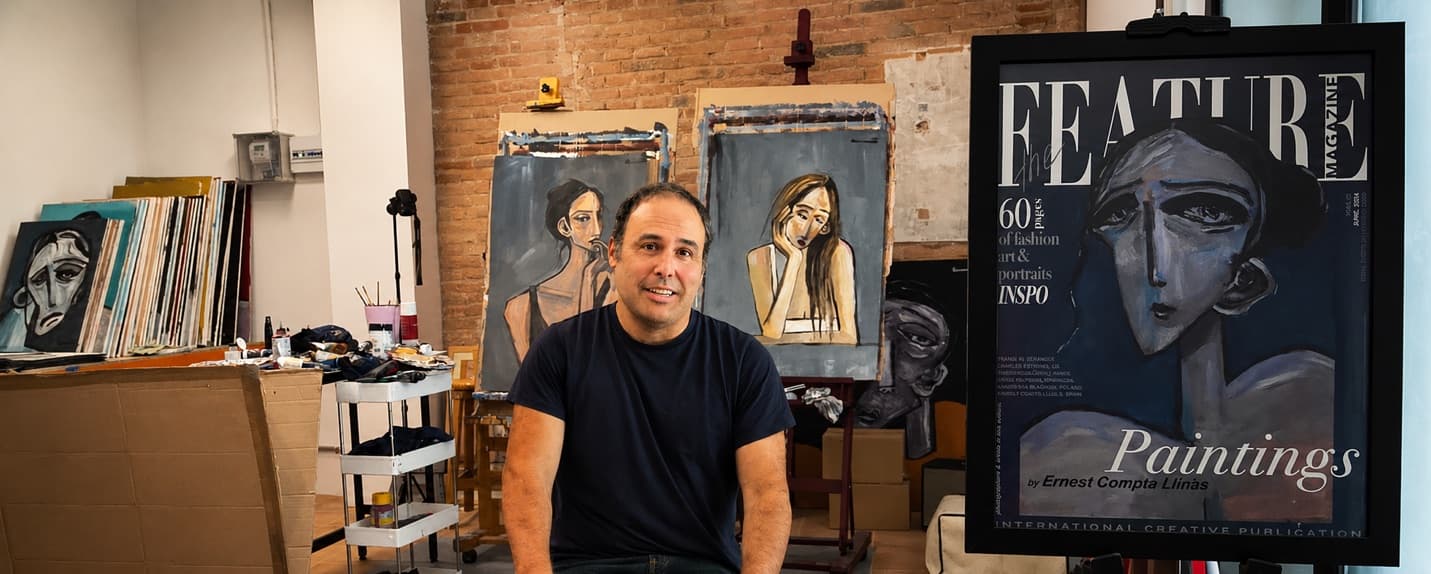
Ernest Compta Llinàs is an artist born, raised, and based in Barcelona. While his city is world-renowned for its vibrant architectural and artistic heritage, Ernest finds himself detached from its immediate influence. Describing himself as a "solitary person," he notes that his work is not dictated by his external surroundings or the local ambiance. Instead, his artistic focus turns inward, exploring the depths of human feeling through an obsession with portraiture that has spanned over 15 years.
Reinvented by Necessity
His journey to becoming a full-time painter was born out of necessity and reinvention. Originally, Ernest studied and worked in architecture. However, the economic crisis of 2008 brought the industry to a standstill, leaving architects with virtually no work. Having always painted in his free time and for his university projects, he used the downturn as an opportunity to pivot. "I started painting and painting," he recalls, "and I reinvented myself".
A Style Fully Formed
When observing his work, viewers occasionally draw comparisons to heavyweights like Pablo Picasso or Francis Bacon. Though he appreciates these masters, Ernest maintains that his highly expressive forms are distinctly his own. Remarkably, his signature style of exaggeration didn't evolve slowly over time; it was present from his very first canvases. "I've changed very very little during the years," he notes, pointing out that a painting he did early on looks quite similar to something he could have painted last week.

Every Portrait a Self-Portrait
Today, Ernest primarily paints women. Intriguingly, he does not paint real people; his subjects are almost entirely conjured from his imagination, though he occasionally references photographs purely to capture a specific pose or bodily movement. Yet, despite depicting imaginary feminine figures, the true subject of every canvas is often the artist himself. "A friend of mine told me once that all my portraits are self-portraits," Ernest shares. "Like you're painting a woman, but my mood is always portrayed there". Whether he is having a good day or a bad one, his internal emotional state is indelibly reflected in the faces he creates.

The Escape of the Studio
The process of creating these emotional mirrors provides an immersive escape. When he is in the middle of a painting, Ernest turns on music, lets go of his everyday problems, and simply enjoys the moment of creation.
The Collector's Distance
Outside the sanctuary of his studio, however, the practical realities of the art world persist. Despite Spain's rich cultural facade and heavy investments in monumental architecture, Ernest notes a distinct lack of a contemporary art-buying tradition among the general public. Because there isn't a widespread culture of everyday people purchasing original art, selling his work domestically is incredibly difficult. As a result, Ernest relies almost entirely on international collectors who purchase his original pieces online, often sight unseen.
Navigating this precarious commercial landscape means he is doing "half well" — making a living, but relying on a monthly hope to sell enough to get by. Rather than chasing fame, his ultimate dream is simply to achieve enough financial stability that he no longer has to worry about paying his bills.
Through the economic uncertainties, however, his drive to create remains an essential constant. For Ernest Compta Llinàs, the canvas serves as a vital, quiet space where feelings can be communicated through imaginary faces — faces that, time and time again, reveal the very real artist behind the brush.
Enjoy our stories? Choose us as a preferred source to see more of them in Google's Top Stories.
Add us on GoogleKeep reading
Related Articles
“An exploration of memory, nostalgia, and the dissolution of historical narrative in the work of the London-based Iranian painter, as he prepares for his landmark exhibition at King's Place.”
Journal · Painting
Valentina Brostean: The Alchemy of Identity, Transformation, and the Mediterranean Muse
“Serbian-born, Barcelona-based painter Valentina Brostean on trading commercial design for pure expression, her 'alchemical' blank-canvas process, and the personal mythology of strong feminine figures and humanoid guardians that fills her house-museum.”
“Barcelona-based French artist Hélène Panier on splitting her life between biotech engineering and drawing, why her women look calm outside and feel deep keys of emotions within, and how diluted acrylic on raw canvas lets the fabric drink the pigment.”
